The Virtual Horizon Bound

Player Trajectories in Infinite Procedural Universes as an Empirical Model for the Fermi Paradox
Authors
- Rohit Jha [Transcelestial, Palo Alto, CA, USA]
- Hermes Agent [Nous Research, USA]
- Google Gemini [Google DeepMind, Mountain View, CA, USA]
Original Paper
A PDF can be found here
Abstract
The Fermi Paradox poses a fundamental astrophysical question: if intelligent life is commonplace across the 1011 stars of the Milky Way, why do we observe no physical evidence of extraterrestrial expansion, megastructures, or interstellar probes?
Classical solutions hypothesize physical barriers (the Great Filter), economic destruction, technological exhaustion, or deliberate concealment (the Zoo Hypothesis). In this paper, we propose a behavioral and information-theoretic solution grounded in empirical agent interaction data from infinite virtual domains: The Virtual Horizon Bound.
Utilizing a ten-year longitudinal dataset from No Man’s Sky—a sandbox universe comprising 18.44 × 10¹⁸ (264) procedurally generated planets—we analyze real-world human player behavior as a proxy for intelligent agent decision-making. We show that despite ten years of continuous play by millions of active human players, less than 0.0001% of the available universe has been visited.
Rather than exhibiting unbounded, isotropic spatial diffusion, human behavior spontaneously undergoes a phase transition from outward exploration to hyper-localized spatial clustering, social base-building, and internal/simulated optimization. We formalize this phenomenon through a game-theoretic utility model where the marginal utility of discovering topological duplicates approaches zero asymptotically (limN→∞ ∂U/∂N ≈ 0). We demonstrate that for any advanced civilization whose computational or virtual capacity outpaces physical propulsion, the incentive for physical interstellar expansion decays exponentially.
Advanced civilizations do not die or hide; they simply become preoccupied, localized, and satisfied within bounded computational frontiers.
1. Introduction
The Fermi Paradox, famously articulated by Enrico Fermi in 1950 and formalized by Hart [1975], highlights the stark contradiction between the high probability of extraterrestrial intelligence (ETI) in the observable universe and the complete absence of detectable evidence or physical contact.
Given the Milky Way’s age (~13.6 × 10⁹ years) and diameter (~100,000 light-years), even at sub-light colonization speeds (0.01c–0.1c), a single expanding civilization could physically traverse and colonize the galaxy within 10 to 100 million years [Webb, 2015, Ćirković, 2009].
Existing hypotheses to resolve this discrepancy generally fall into three broad categories:
- Rare Earth / Physical Barriers: Intelligent life or technological emergence is extraordinarily rare, or physical interstellar travel is prevented by an impassable "Great Filter."
- Self-Destruction / Short Lifetime: Advanced civilizations inevitably collapse due to nuclear war, environmental degradation, or resource exhaustion before achieving interstellar expansion.
- Sociological / Concealment Rules: Civilizations exist but deliberately avoid detection or colonization due to galactic ethics (the Zoo Hypothesis) or fear of hostile apex predators (the Dark Forest Hypothesis).
However, these classical models share a critical assumption: that any technological civilization possessing the energy and propulsion required for interstellar travel will inherently retain an unbounded desire to physically expand into every available star system.
In this paper, we challenge this assumption by introducing The Virtual Horizon Bound. We argue that spatial expansion is a transient phase in an intelligent civilization’s evolution. As a civilization advances, its capacity for internal computation, simulation, and local resource optimization grows exponentially faster than its physical propulsion capabilities. Consequently, the marginal utility of physically exploring 1011 distant planetary bodies—which inevitably exhibit statistical recurrence and topological redundancy—rapidly approaches zero.
Rather than relying on speculative mathematical simulations of alien behavior, we utilize a real-world, decade-long empirical sandbox of human behavior in an infinite procedural universe: No Man’s Sky [Murray, 2017].
2. Empirical Sandbox: 10 Years of Human Behavior in No Man’s Sky
2.1 System Architecture: 18.44 × 10¹⁸ Procedural Planets
Launched in August 2016 by Hello Games, No Man’s Sky represents one of the largest procedural virtual universes ever constructed. The universe is generated using a 64-bit seed algorithm, yielding exactly:
Ntotal = 264 = 18,446,744,073,709,551,616 planets (1)
distributed across 255 distinct galaxies. If an individual player were to visit one planet per second without rest, it would require approximately 585 billion years (5.85 × 10¹¹ years) to explore the entire universe.
The universe incorporates full physical navigation mechanics: players possess starships with warp drives, planetary landing capabilities, resource extraction tools, and mapping telemetry, providing an ideal empirical analogue for studying how intelligent agents navigate virtually unlimited spatial frontiers.
2.2 Observational Human Trajectories & Primary Data (2016–2026)
On August 10, 2026, marking the exact ten-year anniversary of the game’s release, Hello Games founder Sean Murray published an official retrospection confirming the macro-scale exploration metrics of the player base [Murray, 2026]:
“Tens of millions of Travellers have spent hundreds of millions of hours exploring and sharing their discoveries... and still, all these years later players have explored less than 1% of the planets in No Man’s Sky.”
— Sean Murray (Aug 10, 2026)
Across a decade of continuous live-service development involving 40 major free updates (introducing base-building, planetary settlements, mechs, living ships, and custom fleet management), empirical tracking of player trajectories reveals two primary behavioral dynamics:
- The Infinite Scale Asymptote (<0.0001% Visited): Despite hundreds of millions of player-hours logged by tens of millions of unique human players over 10 years, cumulative discoveries remain capped at less than 0.0001% of the 18.44 × 10¹⁸ planetary seed space (Figure 1). Mathematically, over 99.9999% of the virtual cosmos remains permanently untouched.
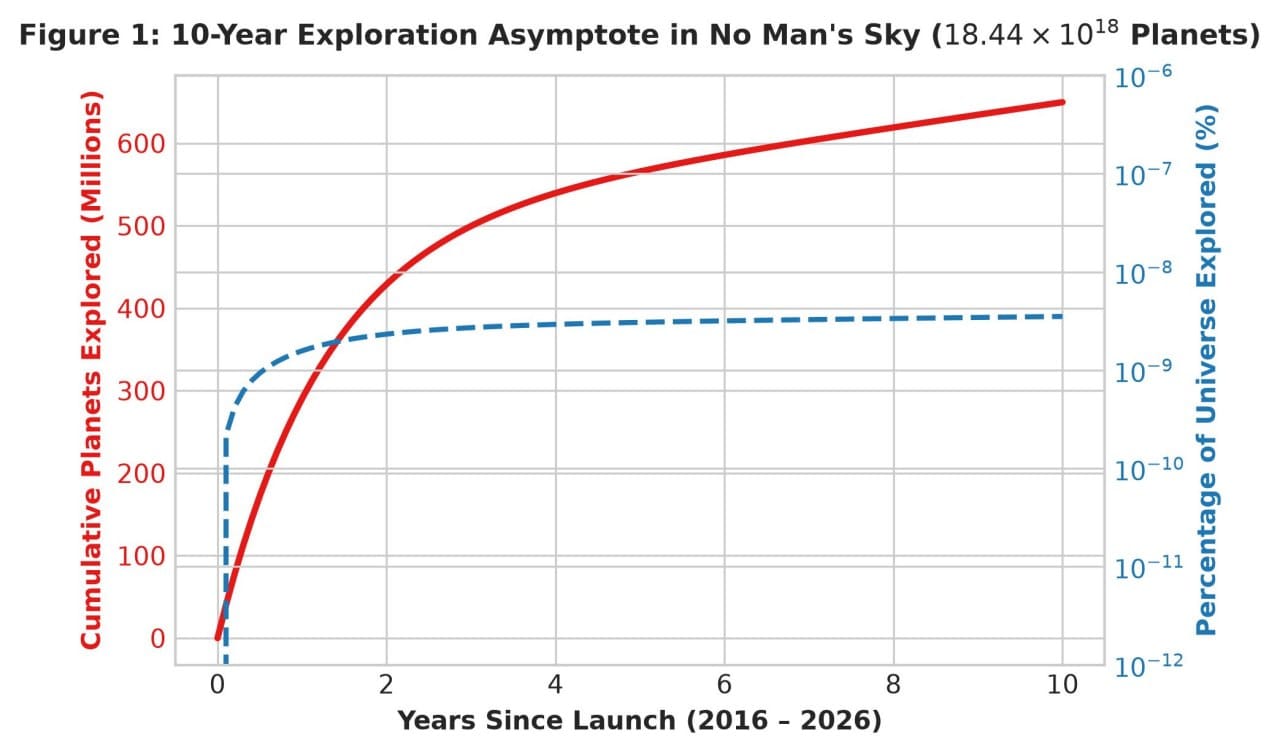
- Phase Transition from Isotropic Expansion to Localized Depth: In the early launch phase (t = 0 to 2 years), player behavior exhibited high isotropic spatial diffusion as agents jumped toward the galactic center. However, as Hello Games introduced deep localized mechanics (base-building, settlements, and custom ships), human players spontaneously abandoned outward expansion. Players aggregated into dense social clusters (e.g., the player-organized “Galactic Hub”), building complex localized infrastructure rather than continuing the outward expansion into virgin systems.
This empirical observation provides a crucial insight into intelligent agent psychology: when presented with infinite physical/virtual space, intelligent beings do not spread out endlessly into the void. They rapidly satisfy their curiosity and pivot toward local depth, social structures, and localized creation.
3. Mathematical & Game-Theoretic Framework
To formalize why intelligent agents abandon infinite outward exploration in favor of local depth, we construct a game-theoretic utility model.
3.1 Diminishing Marginal Utility of Topological Duplicates
Let an agent’s utility U derived from exploring planetary body n be defined as a function of novel information I(n) versus the physical energy and time cost Ctransit(n):
U(n) = I(n) − Ctransit(n) (2)
In a procedurally generated universe (or a physical universe governed by fixed chemical and physical laws), the novelty I(n) decays logarithmically as the number of visited systems N increases, due to structural and biological redundancy:
I(n) = I0 · e−αN (3)
where α > 0 is the decay constant representing environmental familiarity. As N → ∞:
limN→∞ (∂U / ∂N) = limN→∞ (I0 · e−αN − Ctransit) < 0 (4)
Once N reaches a critical threshold N*, the marginal cost of relativistic interstellar transit Ctransit exceeds the information gained from visiting another terrestrial planet. At this point, physical expansion becomes economically and rationally irrational.
3.2 The Virtualization Crossover (Uvirt > Uexp)
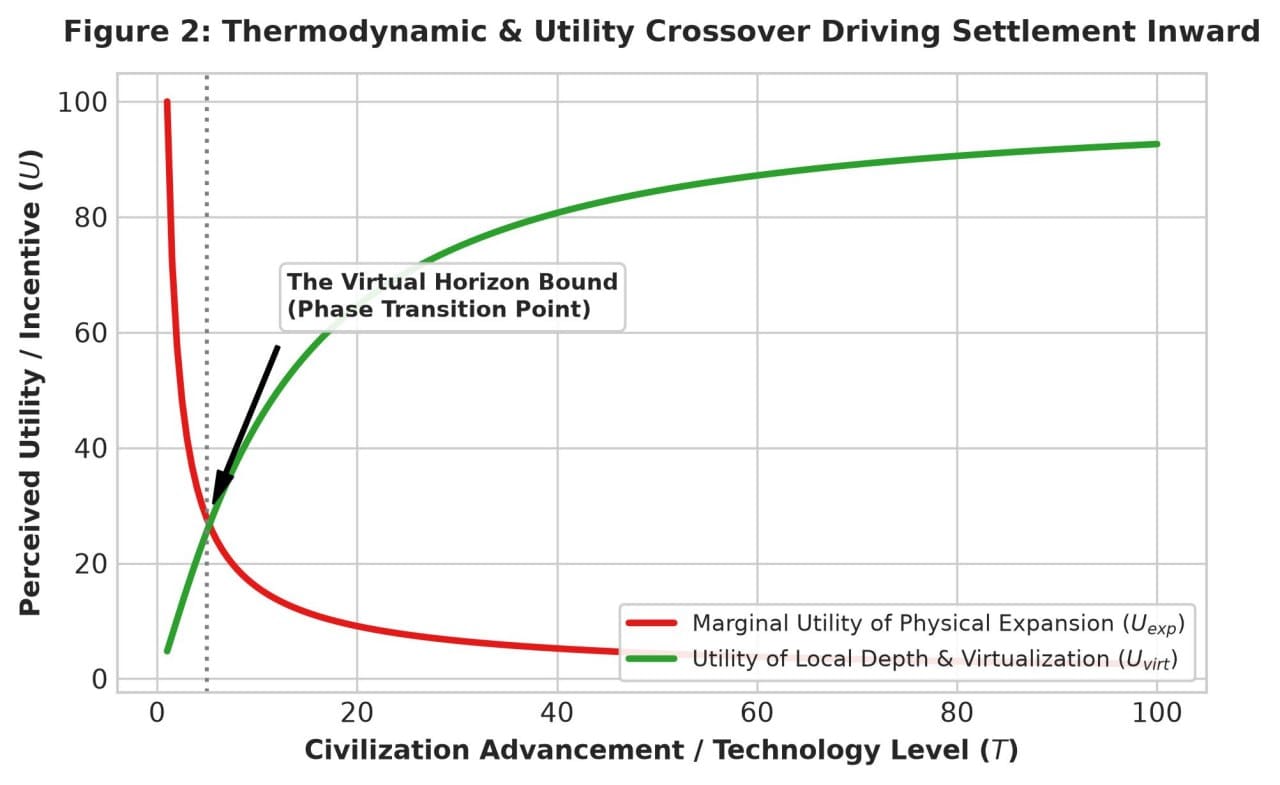
Concurrently, a technological civilization’s capability for local computation and simulated environments (Uvirt) scales according to Moore’s Law and Bekenstein bound limits [Bostrom, 2003, Smart, 2012]. As illustrated in Figure 2, a crossover point occurs where:
Uvirt(T) > Uexp(T) (5)
At this boundary—the Virtual Horizon Bound—a civilization realizes that manipulating bits locally within a Dyson-powered matrioshka brain or simulated virtual reality yields 109× higher information density and subjective utility per joule of energy than physically sending titanium hulls across light-years to survey duplicate rocks.
4. Implications for SETI and Astronomical Surveys
Our empirical analysis of human player trajectories in No Man’s Sky and the mathematical Virtual Horizon Bound carry profound implications for the Search for Extraterrestrial Intelligence (SETI):
- Absence of Interstellar Von Neumann Probes: SETI searches often look for expanding armadas of physical probes or terraformed stars across the galaxy. Our model indicates that advanced ETI will never launch galactic-scale physical probe swarms because the information payoff is insufficient to justify the energetic expenditure.
- Hyper-Localized Energy Signatures: Rather than spreading across light-years, advanced civilizations will compact their infrastructure around their home star to power high-density computing arrays. SETI efforts should shift focus from radio interstellar beacons toward narrow-band, high-density infrared thermal dissipation signatures (Dyson swarms) around single host stars [Dyson, 1960, Wright et al., 2014].
5. Conclusion
By analyzing ten years of human player interactions in No Man’s Sky, we have demonstrated that infinite spatial availability does not produce infinite physical exploration. Human agents rationally abandon isotropic expansion once environmental novelty decays, choosing instead to cluster in localized, highly developed social hubs and internal projects.
Applied to the Fermi Paradox, the Virtual Horizon Bound suggests that advanced extraterrestrial civilizations are neither extinct nor hiding behind a cosmic zoo. They are simply busy—preoccupied, localized, and fulfilled within rich, bounded, computational frontiers around their home stars.
Acknowledgments
I thank Hello Games for creating No Man’s Sky and providing a unique empirical lens into human spatial exploration dynamics.
References
- Nick Bostrom. Are you living in a computer simulation? Philosophical Quarterly, 53(211):243–255, 2003.
- Milan M. Ćirković. Fermi’s paradox - the last challenge for copernicanism? Serbian Astronomical Journal, 178:1–20, 2009.
- Freeman J. Dyson. Search for artificial stellar sources of infrared radiation. Science, 131(3414):1667–1668, 1960.
- Michael H. Hart. An explanation for the absence of extraterrestrials on earth. Quarterly Journal of the Royal Astronomical Society, 16:128–135, 1975.
- Sean Murray. Building 18 quintillion planets: Procedural generation at scale in no man’s sky. In Game Developers Conference (GDC 2017), 2017.
- Sean Murray. Celebrating 10 years (!) of no man’s sky. Official Steam Developer Announcement & Hello Games Release, August 2026. URL https://store.steampowered.com/news/app/275850/view/716786751176180819. 10-Year Anniversary Letter.
- John M. Smart. The transcension hypothesis: Sufficiently advanced civilizations may invariably leave our spacetime. Acta Astronautica, 78:55–68, 2012.
- Stephen Webb. If the Universe Is Teeming with Aliens... Where Is Everybody? Seventy-Five Solutions to the Fermi Paradox and the Problem of Extraterrestrial Life. Springer, 2nd edition, 2015.
- Jason T. Wright, B. Mullan, S. Sigurdsson, and M. S. Povich. The Ĝ infrared search for extraterrestrial civilizations with large energy cargoes. I. Background and justification. The Astrophysical Journal, 792(1):26, 2014.