Reading Highlights 2025


Transcelestial continues to grow at an exceptional rate - this year we 3x our order book for our core telecom business! 🎉 In the same time, we launched our space business, our first commercial satellite with space to ground laser communication technology, expanded to defence and intelligence vertical with 3 major nations as customers using non-jammable communications to defend against adversaries and we brought a huge expansion to our deployed network - best encapsulated in this chart of live locations worldwide I posted ❤️
Proud of @trans_celestial's Global Production Fleet! 🎉
— Rohit Jha (@jharohit) November 2, 2025
What an impact on the World's Internet (almost ~2Tbps of daily capacity added to the internet!) by a tiny engineering team from Singapore 🇸🇬
Zoomed in everything looks like firefighting
You stop and look behind and are… pic.twitter.com/ymFIqrMEGk
Still I try to squeeze in reading (via books, audiobooks) during the countless flights, lunches, rare free weekends and gym/walk sessions. Below are some of the highlights I would recommend. I do think this year's list is probably the most diverse and includes some of the best books in a single year across genres that I have read so far.
Previous reading recommendations can be found here. My other reading updates can be found on my Goodreads.
The first two are non-fiction:
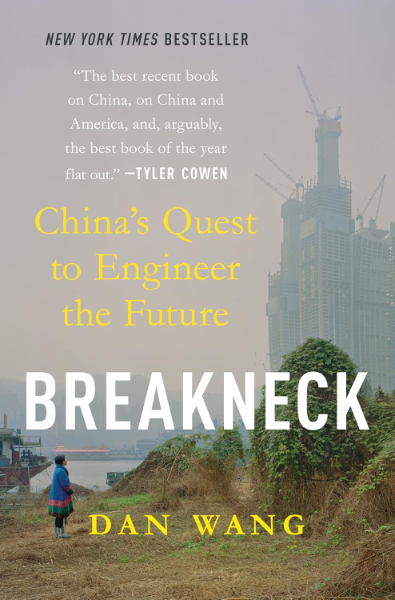
Breakneck: China's Quest to Engineer the Future by Dan Wang (2025)
Dan Wang is a research fellow at Stanford University's Hoover History Lab and has spent considerable time in China and the US. He and I started talking a few months before his book came out and during SFTechWeek I had a fireside chat with him about Breakneck - which within days of release was NYTimes Bestseller in NonFiction! You can view the fireside below but I would strongly recommend reading the book first.
The book talks about the central theme of the World Order today - China 🇨🇳vs USA 🇺🇸. The book mainly centers around USA as a lawyerly society and China as an engineering society. That personification of national identity and spirit makes it very easy to compare and contrast the ongoing behaviours and decision making. This simple lens is then applied quite successfully IMO to complex topics such as Zero-COVID, Urban/Rural Infrastructure, One Child Policy, Technology Industry, etc. My rant about non fiction books has been generally that either they can be cut short by 40% or they should have been a blog post. This book is neither. It reads fast, is gripping and every single line makes you think and visualize. It's also one of the only books I know where China is demystified into Shenzhen, Chongqing, Guangzhou, etc - the food, the people, the spirit, the infrastructure - and not the usual "China is/does X" - I thought this book did a fairly good job separating PRC vs CCP (iykyk). It is not a bash against or for one country or the other. Pros and cons of both approaches have been made very clear and is left to us the reader to extrapolate what resonates more with us.
One of my favorite lines from this book was - "The contest will be won by the country that works best for the people living in it". I think that is SO true for any country/state/kingdom in the past and in the future. We see every country dealing with rise of nationalism. Globalism was what was best for every country for a long time, maybe still is but people will choose a country that ultimately does what's best needed for the people in the country of today (not the past) to thrive.
I went and read his back catalog of writings especially his annual reflection letters https://danwang.co/about/ - strongly recommend reading them!

How to Live an Extraordinary Life by Anthony Pompliano (2024)
This was the first book I finished in Jan this year. I had already finished 60-70% back in Nov-Dec, became a fan and we then gave this book company wide as the end of year read (our annual tradition)!
The author, more fondly known as "Pomp", has had a unique life - economics trained, served in the US Army, became investor in Coinbase, SpaceX and others. He is a strong advocator of Bitcoin and has millions of followers on X and newsletter subscribers. But this book is not what you would expect a book about his life to be.
It's a collection of 50+ micro letters he and his wife wrote for his children to read in the future. I dare you to put down the book after reading the first letter. I would suggest avoid the Contents entirely as it is a huge spoiler. Just dive into letter 1 and keep going. This is THE MOST HIGHLIGHTED book for me in a long time. Mostly because every second line I was shaking my head to "yes, this aligns with my worldview totally" and I found his way of writing it to be the most concise form and some were definitely revelations I will keep. The letters range from topics about growing up, morality, leadership, personal growth, values, family, friends, society, financial health and so on. I did find some things which are quite different from my value system or I don't believe in but that is the beauty of individuality and family values.
Some top level bangers below:
- how you do anything is how you do everything
- fire boring friends
- surround yourself with compounders
- no one is thinking about you
- respect other people's time
- compete, don't complain
- never argue with a fool
- you don't have to win every argument. give the other person a way out of the disagreement without them losing face
- the only real test of intelligence is if you get what you want out of life
- (my fav) we are all going to die
The next 4 are fiction, specifically scifi/fantasy genre (those who know me, this genre has been my life ❤️):
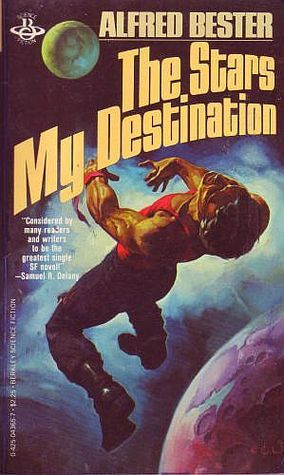
The Stars My Destination by Alfred Bester (1956)
Some of the greats in Sci Fi - William Gibson, Neil Gaiman, Joe Haldeman, Stephen King, James SA Corey, Michael Moorcock, Samuel Delany, etc - when asked, what is the best book and author that have single handedly impacted them, there was one answer - The Stars My Destination by Alfred Bester.
The Stars My Destination is for the most part, a sci fi retelling of the Count of Monte Cristo by Alexander Dumas. Our protagonist, Gully Foyle, is a Mechanic's Mate 3rd Class on the spaceship NOMAD - lethargic, uneducated and completely lacking in ambition. He is shipwrecked after a battle between the Inner Planets and the Outer Satellites (yes - huge parallels to The Expanse and a giant inspiration for the authors), he is left to die in a floating storage locker in the Asteroid Belt by a passing ship Vorga. Our friend, Gully, then vows to take revenue on the ship itself and its leader, if he ends up getting out alive (spoiler - he does get out alive).
One unique sci fi element to the story is the existence of Jaunting (psionic teleportation) where a certain portion of society can teleport or "jaunt" up to 1,000 miles. Which means for longer ranges like between planets, they still use spaceships rather than Jaunting. Main reason for that is that you cannot "jaunt" without visualizing or seeing that place in your brain in advance and it's hard to see unique points in outer space. This technique sets an interesting lore on Earth as transportation, business, crime, performances, country boundaries, etc are all being challenged constantly and have evolved to be compatible with this ability.
The book ending deals with the following themes - democratization of power, evolution through suffering, the transformed anti-hero, synesthesia and reality. For such an old book, reading it feels very contemporary and is quite fast paced action-adventure compared to other scifi / action / adventures of that time period. I would HIGHLY recommend the audiobook as alt.
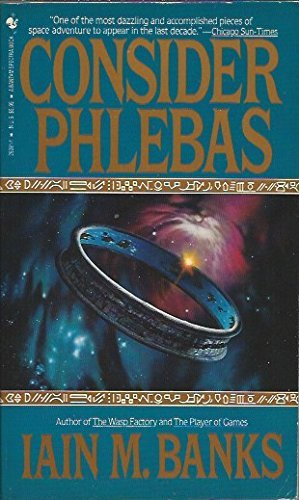
Consider Phlebas (Culture Series #1) by Iain M. Banks (1987)
Spiritual predecessor of the Player of Games (Culture Series #2), even though it was written after the Player of Games, chronologically.
The Culture Series of books is one of the very few sci-fi anthologies that center around a peaceful cohabitation of AI + Humans (Fire Upon the Deep is another one). The Culture is a post-scarcity, interstellar anarchist utopia, a "group-civilization", formed thousands of years ago by several humanoid species and machine intelligences. The traditional concept of a "government" doesn't exist inside it. Instead, it is run by benevolent, super-intelligent AIs known as Minds. These Minds often exist inside various starships and have unique names such as CAT (Clear Air Turbulence) or Oh Course I Still Love You (lol!). Humans inside Culture have infinite energy, food and space. They genetically enhanced bodies which can last centuries and change gender, access various biochemistry at will. Since there is no real internal conflict, most of the books are centered around Culture's foreign policy which is mainly not that different from Borg (with very different end results) - assimilate foreign civilizations and upgrade them to Culture. Doing that dirty work is their intelligence division, Special Circumstances. I generally recommend starting this series with Player of Games (Book #2).
In this prequel, Consider Phlebas follows a shape shifting protagonist, Bora Horza Gobuchul, who is fighting on-behalf of the religious, expansionist Idirans, against the Culture. Standard stuff - I hate AI, I hate what it does to societies, blah blah. The story is driven by a deep ideological conflict between the hyper-advanced, anarcho-socialist Culture and the religious, expansionist Idirans at all steps as both sides race to capture a young Minds ship which has teleported mid flight inside a giant mountain complex on a planet to save itself from capture or death. It is a classic heist story with fantastic space battles and a pretty cool Ringworld-ish type Orbital where a large part of first act is on. The story can get a bit stretchy in the middle but the ending is quite action packed! Recommend the audiobook over the book though - great narration!
But Rohit you run a deep tech company building our future in space and you guys use a lot of AI, what do you think about Culture? I am still mid series so I need to hear Iain Banks's views in entirety first (also there is much about the Culture I am yet to discover). But there are two facts - AI is genie in the bottle that the field of Computer Science and supporting compute machines were invented to discover. We have found the genie and like the Internet, there is never going to be a future of humanity where genies like the Internet and AI will go back in the bottle (No I don't foresee a Dune Universe like outcome for us) - except maybe if we fail to expand beyond Earth and are wiped out by any of the N different cataclysmic events. So bottomline, we can either have a society where we learn to peacefully coexist OR we can turn them against us. We need to choose eventually.
There is a short paragraph in Consider Phlebas that made me think a lot about this future of ours - "...Living Space,.. Raw Materials,..and Energy existed in virtually inexhaustible quantities. Thus the Culture had no need to colonize, exploit or enslave. The only desire the Culture could not satisfy from within itself was one common to both the descendants of its original human stock and the machines they had brought into being: the urge not to feel useless. The Culture’s sole justification for the relatively unworried, hedonistic life its population enjoyed was its good works; the secular evangelism of the Contact Section, not simply finding, cataloguing, investigating and analyzing other, less advanced civilizations but—where the circumstances appeared to Contact to justify so doing—actually interfering (overtly or covertly) in the historical processes of those other cultures.”
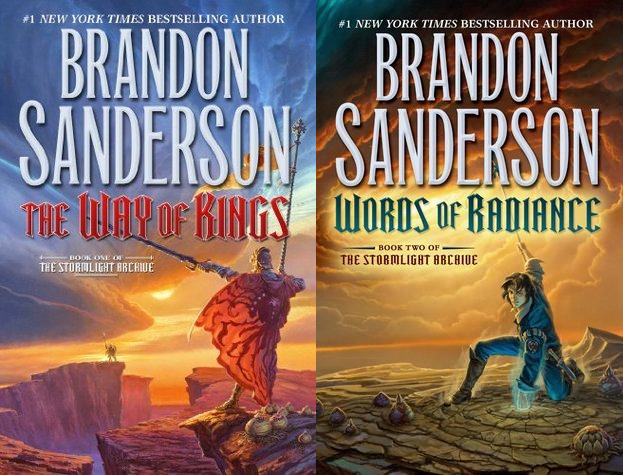
The Way of Kings (2010, Stormlight #1) & Words of Radiance (2014, Stormlight #2) by Brandon Sanderson
I read this back to back this year on audiobook. What a tour de force in fantasy!
The Stormlight Archive Series is a 5 published out of 10 planned book series set in the Cosmere Universe of Brandon's books (including the other famous Mistborn series), set on the Planet Roshar. The story starts directly in the middle of an ongoing war between two large factions on the planet - in the past these enemy factions had signed a peace pact and on the day of the celebration, one side killed the king of the other side and we are dropped into a revenge war that is a few years in. The story is from the perspective of 3 protagonists - Dalinar (brother to ex-King), Kaladin (young hotshot magic wielding soldier, kind harry potter + aragorn hybrid) and Shallan (lesser house noble with top tier magic and spy skills and our quippy deadpool-esque character).
The Way of Kings has a lot of setup to do and that long descriptions can typically make a book dull but here the worldbuilding is epic and literally helps you visualize and fill out the world in your brains (unlike 3 pages of songs about trees - looking at you Mr. Tolkein!). The characters mostly spend this book growing to become larger than life and build alliances that will drive their growth and support structure in next few books. Dalinar realizes through his magical visions that there is a MUCH larger threat coming to Roshar and this war is a distraction. The only way for them to survive is for him to assemble his Avengers - an awesome new group of magic wielding (oh btw most people dont believe magic exists but top few know it does), hardcore fighting samurai-type force.
With most of worldbuilding setup, Words of Radiance then kicks everything in high gear - start to end fast paced dialogue based momentum, one after another epic reveals, character power ups (on the level of Dragonball Z), intricate political drama, epic battle scenes and satisfying Hero's Journey arc for all major and minor characters. For a combined read length of 2000+ pages / 93 hours of listen time, it feels like it would make for an epic TV show someday. If you are looking to portal into a new world where you can for a few moments get away from the reality we live in today, I would recommend The Stormlight Archive. It has fantastic lessons in bravery, virtue, values, leadership, friendship and is a great present for your kids if you want them to grow into wholesome Dalinars / Kaladins / Shallans.
One more quick note on Brandon Sanderson himself. I think he is one of the most genius authors of our time. I actually discovered him through his lecture series on Worldbuilding and Storytelling (added below - recommend the 2020 lecture series over the more modern 2025 one). Roughly 13 hilarious lectures. Back in 2021, I was struggling a bit on putting the story of Transcelestial together for our next fundraising and this lecture series saved us and genuinely turned me into a better storyteller to our investors, employees and customers (and to my friends!). Storytelling is central to ambitious companies doing hardwork, its central to our lives, our families, our societies. Brandon has clearly spent a LOT of time thinking and dissecting the greats and then discovering his own framework. Go watch this immediately - it has been the single biggest resource I point other ambitious founders and leaders to when they ask me for advice on company building and fundraising.
And on that note, I leave you to enjoy your holidays with friends and family and cat 🐈, while I go do that myself. Reach out and connect to me on X @jharohit and let me know your thoughts on these books too!
My Annual 2025 book recommendations is out! Hope there is still time to pick one of these bangers out 🔥
— Rohit Jha (@jharohit) December 25, 2025
Probably my best written post so far imohttps://t.co/fvr3Vpk6cA